Route by Rubite
Discover Rubite as you walk through its streets and explore the different points that are part of its history:

A walk through Rubite following the traces of time
The name Rubite, according to some, derives from Mozarabic language and means ‘bramble’ or ‘blackberry’, whilst the most widely accepted and plausible hypothesis suggests an Arabic origin, meaning ‘small rábita’ (fortified hermitage). Its inhabitants are known as ‘rubiteños’ or by the colloquial patronymic ‘los Güenos’.
The first traces of human habitation in Rubite date back to the Copper Age (2500–1800 BC), with evidence of a mid-mountain settlement in the vicinity of Cortijo del Peñón. With the arrival and spread of Islam across the Iberian Peninsula, the Arabs settled in Ubrite (the farmstead or cortijo of Rubite el Alto) around the 10th century, and Rubite was settled in the following century.
Following the Christian conquest of the Kingdom of Granada in the early 16th century, Rubite and its surroundings, which belonged to the taha (administrative district) of Suhayl, became part of the Cehel district, a part of the entailed estate established in 1512 by Luis Zapata Portocarrero and María de Chaves, who were granted favors and privileges by the Crown in recognition of their services. This estate later passed into the hands of the Count of Cifuentes and ultimately to the Count of Santa Coloma.
After the expulsion of the Moriscos, like the rest of the villages in the area, Rubite was repopulated in 1588, but its population growth really took off in the second half of the 18th century. The districts of Haza Llana and part of Pecho were added to the village, which until then had consisted of the three original Nasrid districts (Cerrillo, Iglesia and Chorro). The rest of its territory was gradually occupied by numerous farmsteads, significantly expanding the number from the three that existed in the 17th century.
The prosperity of the vineyards led to a population boom and Rubite reached almost 2,200 inhabitants by 1877, when its wines won several prizes at the Madrid Agricultural Exhibition. However, the phylloxera epidemic in 1883 devastated the vineyards and ruined most of Rubite’s humble families. The situation was exacerbated by several adverse weather events during this decade and by the catastrophic earthquake on Christmas Day 1884 and its powerful aftershocks in early January 1885. All this, coupled with the authorities’ indifference and their oppressive tax policies, led to a tragic exodus of people to various countries in the Americas and other regions of Spain.
From 1920 to 1950, despite the constraints of the Civil War, population levels gradually recovered but did not reach those of 1877. However, the harsh post-war autarky and the subsequent crisis of 1973 led to a new exodus of people – seasonal or permanent – to the Americas, France, large Spanish cities and the nearby coast – due to the new opportunities presented by greenhouse farming –, resulting in a population of 434 inhabitants by 2024.
The appearance of the old village has changed significantly over time; in fact, at the entrance, on Avenida de Andalucía, there are some historic sites and buildings that have undergone considerable changes.
Fountain, threshing floor, drying ground and cemetery

Moorish cemetery and Christian Way of the Cross
Placeta del Diezmo
Mirador del Tajo
Flour mill and still for spirits
The surroundings of the former mosque
In the Morisco Chorro district
The church

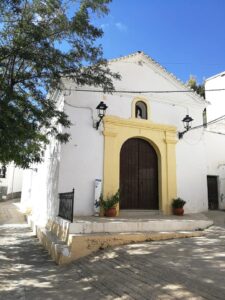
Dedicated to the Immaculate Conception, the church was completed around 1721. Built in the Mudejar style and of the same dimensions as the original one, the central nave has a hip roof structure. Its façade consists of a semicircular arch framed by pilasters with a simple entablature, topped with a niche with the effigy of the Immaculate Conception. Despite its various alterations and modifications and the consequent loss of heritage items such as the pulpit, paintings and candlesticks, it nevertheless contains some sculptures of considerable artistic and sentimental value to the people of Rubite: in addition to the original baptismal font, as well as some pieces of stonework and gold and silverwork, it houses a number of books linked to worship from different periods. As well as being a place of worship, it also served as a refuge for the residents and as a bivouac for the army.

Dedicated to the Immaculate Conception, the church was completed around 1721. Built in the Mudejar style and of the same dimensions as the original one, the central nave has a hip roof structure. Its façade consists of a semicircular arch framed by pilasters with a simple entablature, topped with a niche with the effigy of the Immaculate Conception. Despite its various alterations and modifications and the consequent loss of heritage items such as the pulpit, paintings and candlesticks, it nevertheless contains some sculptures of considerable artistic and sentimental value to the people of Rubite: in addition to the original baptismal font, as well as some pieces of stonework and gold and silverwork, it houses a number of books linked to worship from different periods. As well as being a place of worship, it also served as a refuge for the residents and as a bivouac for the army.